

What Is The Difference Between Perceived Pitch, And Sound Frequencies In A Waveform In Animate Cc
9.iv: Speed of Sound, Frequency, and Wavelength
- Page ID
- 200175
Learning Objectives
By the end of this department, you lot will be able to:
- Ascertain pitch.
- Draw the human relationship between the speed of sound, its frequency, and its wavelength.
- Describe the effects on the speed of sound every bit it travels through various media.
- Describe the effects of temperature on the speed of audio.
Sound, like all waves, travels at a certain speed and has the properties of frequency and wavelength. You can notice directly evidence of the speed of audio while watching a fireworks brandish. The flash of an explosion is seen well before its sound is heard, implying both that sound travels at a finite speed and that it is much slower than light. You can too directly sense the frequency of a sound. Perception of frequency is called pitch. The wavelength of audio is not directly sensed, but indirect evidence is found in the correlation of the size of musical instruments with their pitch. Minor instruments, such every bit a piccolo, typically make loftier-pitch sounds, while large instruments, such as a tuba, typically brand depression-pitch sounds. High pitch means small wavelength, and the size of a musical musical instrument is straight related to the wavelengths of sound it produces. And then a small musical instrument creates brusque-wavelength sounds. Like arguments concur that a large instrument creates long-wavelength sounds.
 Figure \(\PageIndex{i}\): When a firework explodes, the light energy is perceived before the audio energy. Sound travels more slowly than low-cal does. (credit: Dominic Alves, Flickr)
 The relationship of the speed of audio, its frequency, and wavelength is the same as for all waves:
\[v_w = f\lambda,\]
where \(v_w\) is the speed of sound, \(f\) is its frequency, and \(\lambda\) is its wavelength. The wavelength of a sound is the distance between adjacent identical parts of a moving ridge—for example, between adjacent compressions as illustrated in Figure \(\PageIndex{ii}\). The frequency is the aforementioned as that of the source and is the number of waves that pass a point per unit fourth dimension.
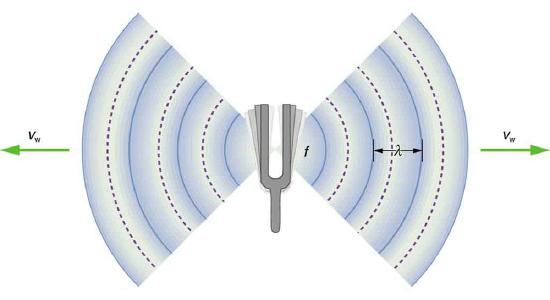 Effigy \(\PageIndex{2}\): A sound moving ridge emanates from a source vibrating at a frequency \(f\), propagates at \(v_w\), and has a wavelength \(\lambda\).
 Table \(\PageIndex{ane}\) makes information technology credible that the speed of sound varies greatly in different media. The speed of sound in a medium is adamant by a combination of the medium's rigidity (or compressibility in gases) and its density. The more than rigid (or less compressible) the medium, the faster the speed of sound. For materials that have similar rigidities, sound will travel faster through the i with the lower density because the sound energy is more easily transferred from particle to particle. The speed of sound in air is low, because air is compressible. Because liquids and solids are relatively rigid and very difficult to shrink, the speed of sound in such media is generally greater than in gases.
| Medium | \(v_w(m/south)\) |
|---|---|
| Gases at \(0^oC\) | |
| Air | 331 |
| Carbon dioxide | 259 |
| Oxygen | 316 |
| Helium | 965 |
| Hydrogen | 1290 |
| Liquids at \(20^oC\) | |
| Ethanol | 1160 |
| Mercury | 1450 |
| Water, fresh | 1480 |
| Sea water | 1540 |
| Human tissue | 1540 |
| Solids (longitudinal or bulk) | |
| Vulcanized rubber | 54 |
| Polyethylene | 920 |
| Marble | 3810 |
| Drinking glass, Pyrex | 5640 |
| Atomic number 82 | 1960 |
| Aluminum | 5120 |
| Steel | 5960 |
Earthquakes, essentially sound waves in Earth'south crust, are an interesting example of how the speed of sound depends on the rigidity of the medium. Earthquakes have both longitudinal and transverse components, and these travel at dissimilar speeds. The bulk modulus of granite is greater than its shear modulus. For that reason, the speed of longitudinal or pressure level waves (P-waves) in earthquakes in granite is significantly college than the speed of transverse or shear waves (S-waves). Both components of earthquakes travel slower in less rigid fabric, such as sediments. P-waves accept speeds of 4 to vii km/s, and Southward-waves correspondingly range in speed from 2 to v km/s, both existence faster in more rigid material. The P-wave gets progressively further alee of the Southward-wave as they travel through Earth'due south crust. The time betwixt the P- and S-waves is routinely used to make up one's mind the distance to their source, the epicenter of the earthquake.
The speed of audio is affected by temperature in a given medium. For air at bounding main level, the speed of sound is given by
\[v_w = (331 \, m/south)\sqrt{\dfrac{T}{273 \, Yard}},\]
where the temperature (denoted as \(T\)) is in units of kelvin. The speed of sound in gases is related to the average speed of particles in the gas, \(v_{rms}\), and that
\[v_{rms} = \sqrt{\dfrac{three \, kT}{m}},\]
where \(k\) is the Boltzmann constant \((one.38 \times x^{-23} \, J/K)\) and \(chiliad\) is the mass of each (identical) particle in the gas. And then, it is reasonable that the speed of sound in air and other gases should depend on the square root of temperature. While not negligible, this is not a potent dependence. At \(0^oC\), the speed of sound is 331 thou/s, whereas at \(20^oC\) information technology is 343 m/south, less than a four% increase. Figure \(\PageIndex{3}\) shows a use of the speed of sound by a bat to sense distances. Echoes are also used in medical imaging.
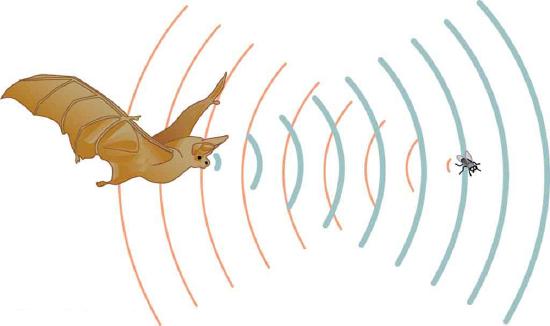 Figure \(\PageIndex{3}\): A bat uses audio echoes to find its manner almost and to catch prey. The time for the echo to return is directly proportional to the distance.
 One of the more important properties of sound is that its speed is almost contained of frequency. This independence is certainly true in open air for sounds in the audible range of 20 to 20,000 Hz. If this independence were not true, you would certainly notice information technology for music played by a marching band in a football game stadium, for example. Suppose that high-frequency sounds traveled faster—then the farther yous were from the band, the more than the audio from the low-pitch instruments would lag that from the high-pitch ones. But the music from all instruments arrives in cadence contained of altitude, and then all frequencies must travel at nearly the same speed. Recall that
\[v_w = f\lambda.\]
In a given medium under fixed conditions, \(v_w\) is constant, then that there is a relationship between \(f\) and \(\lambda\); the college the frequency, the smaller the wavelength. Meet Figure \(\PageIndex{4}\) and consider the following instance.
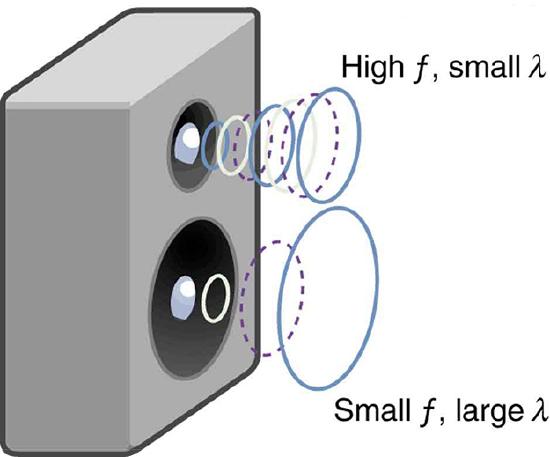 Figure \(\PageIndex{4}\): Because they travel at the same speed in a given medium, depression-frequency sounds must have a greater wavelength than loftier-frequency sounds. Hither, the lower-frequency sounds are emitted by the large speaker, called a woofer, while the higher-frequency sounds are emitted by the small speaker, called a tweeter.
 Instance \(\PageIndex{i}\): Calculating Wavelengths: What Are the Wavelengths of Audible Sounds?
Summate the wavelengths of sounds at the extremes of the audible range, 20 and 20,000 Hz, in \(30.0^oC\) air. (Presume that the frequency values are accurate to two significant figures.)
Strategy
To observe wavelength from frequency, we tin can utilize \(v_w = f\lambda\).
Solution
- Place knowns. The value for \(v_w\), is given by \[v_w = (331 \, m/due south)\sqrt{\dfrac{T}{273 \, K}}. \nonumber\]
- Convert the temperature into kelvin and and so enter the temperature into the equation \[v_w = (331 \, one thousand/s)\sqrt{\dfrac{303 \, G}{273 \, K}} = 348.vii \, m/due south. \nonumber\]
- Solve the relationship between speed and wavelength for \(\lambda\): \[\lambda = \dfrac{v_w}{f}. \nonumber \]
- Enter the speed and the minimum frequency to give the maximum wavelength: \[\lambda_{max} = \dfrac{348.7 \, grand/s}{twenty \, Hz} = 17 \, grand. \nonumber\]
- Enter the speed and the maximum frequency to give the minimum wavelength: \[\lambda_{min} = \dfrac{348.seven \, k/due south}{twenty,000 \, Hz} = 0.017 \, m = 1.7 \, cm. \nonumber\]
Give-and-take
Considering the product of \(f\) multiplied by \(\lambda\) equals a constant, the smaller \(f\) is, the larger \(\lambda\) must be, and vice versa.
The speed of sound can change when sound travels from one medium to another. All the same, the frequency unremarkably remains the aforementioned because it is similar a driven oscillation and has the frequency of the original source. If \(v_w\) changes and \(f\) remains the same, so the wavelength \(\lambda\) must change. That is, because \(v_w = f\lambda\), the higher the speed of a audio, the greater its wavelength for a given frequency.
MAKING CONNECTIONS: Accept-HOME INVESTIGATION - VOICE Every bit A SOUND Wave
Append a sail of paper so that the top edge of the paper is fixed and the lesser border is free to move. Yous could tape the elevation edge of the paper to the edge of a table. Gently blow virtually the edge of the bottom of the sheet and note how the sheet moves. Speak softly and then louder such that the sounds hit the edge of the lesser of the paper, and note how the sail moves. Explain the effects.
Exercise \(\PageIndex{1A}\)
Imagine you detect two fireworks explode. You hear the explosion of ane as soon equally you run across it. Notwithstanding, you see the other firework for several milliseconds before you hear the explosion. Explicate why this is so.
- Respond
-
Sound and calorie-free both travel at definite speeds. The speed of sound is slower than the speed of light. The first firework is probably very shut by, so the speed divergence is not noticeable. The 2d firework is farther away, then the light arrives at your eyes noticeably sooner than the sound wave arrives at your ears.
Exercise \(\PageIndex{1B}\)
You find ii musical instruments that yous cannot identify. One plays high-pitch sounds and the other plays low-pitch sounds. How could you make up one's mind which is which without hearing either of them play?
- Answer
-
Compare their sizes. High-pitch instruments are generally smaller than depression-pitch instruments considering they generate a smaller wavelength.
Summary
- The relationship of the speed of sound \(v_w\), its frequency \(f\), and its wavelength \(\lambda\) is given by \(v_w = f\lambda,\) which is the same human relationship given for all waves.
- In air, the speed of sound is related to air temperature \(T\) past \(v_w = (331 \, m/s) \sqrt{\dfrac{T}{273 \, One thousand}}.\) \(v_w\) is the aforementioned for all frequencies and wavelengths.
Glossary
- pitch
- the perception of the frequency of a audio
Source: https://chem.libretexts.org/Courses/Colorado_State_University_Pueblo/Elementary_Concepts_in_Physics_and_Chemistry/09:_Chapter_9_-_Waves/9.04:_Speed_of_Sound,_Frequency,_and_Wavelength
Posted by: weissthemanty.blogspot.com
0 Response to "What Is The Difference Between Perceived Pitch, And Sound Frequencies In A Waveform In Animate Cc"
Post a Comment