

1. In The Mesozoic Era, Angiosperms Rapidly Expanded. Which Group Of Animals Mirrored It?


GEOL 104 Dinosaurs: A Natural History
Fall Semester 2021
In the Shadow of the Dinosaurs: Mesozoic Mammals and Plants
Key Points:
•Mammals are a branch of therapsid synapsids.
•Most of mammalian history occurred within the Mesozoic. Many features passed on to modern mammals (loss of practiced color vision; whiskers; etc.) seem to represent adaptations as generally nocturnal animals during the Age of Dinosaurs.
•Mammals were quite diverse during the Mesozoic, evolving (multiple times!) into tree-climbing, burrowing, swimming, gliding, and other modes of life
•Many groups of mammals died out at the same extinction that took at the large dinosaurs, but others survived (including lineages which have since gone extinct
•Ane of the most of import groups of organisms to evolve during the Mesozoic are the angiosperms (flowering plants). Unlike other seed plants, angiosperms employ flowers to "ransom" insects and others to spread their pollen, and fruit to lure vertebrates (including herbivorous dinosaurs) to spread their seeds.
On country during the Mesozoic, there were plenty of organisms other than dinosaurs. Amidst the most of import (especially for u.s.a.!) were the mammals.
Mammals and their closest relatives (more than properly Mammaliaformes, or sometimes "Mammaliformes") appear in fossil record the same fourth dimension as dinosaurs, in Late Triassic.
Mammals are very avant-garde therapsids synapsids.
True mammals (Mammalia) found from Late Triassic onward (if the group Haramayida is part of Mammalia proper) or the Early Jurassic (if not). In the modern world, mammals are hands recognized past numerous synapomorphies:
- A trunk covering of fur
- At to the lowest degree moderate levels of endothermy (and in most groups quite high levels)
- The namesake attribute mammary glands, and with these suckling young and long periods of parental intendance
- Mammary glands themselves are modified from another mammalian trait: sweat glands
- Very large brains (only birds rival mammals in brain/trunk size)
- Complex chewing doable by an anisognathus jaw (that is, a lower jaw slightly smaller than the upper jaw, allowing it to move side-to-side and/or back-and-forth
- Teeth differentiated into nipping incisors, biting canines, and grinding premolars and molars
- The molars in particular are highly complex, with a multifariousness of cusps, crests, lophs, basins, and other structures assuasive for a broad diversity of grinding, slicing, crushing, etc.
- Deciduous dentition: that is, only 2 sets of teeth (baby and adult), rather than continuous renewal of teeth throughout their lives
- A lower jaw fabricated up of only a single os on each side. That bone is equivalent to the tooth-begetting bone of most other vertebrates (the dentary).
- Some of the basic that make up the posterior of the lower jaw in other vertebrates are reduced in size and incorporated into the mammalian heart ear. These act to amplify sounds (especially higher frequency) relative to what unmarried-bone-eared animals can hear.
- Fifty-fifty in mod mammals, these ear ossicles brainstorm to develop in the lower jaw in embryos and drift to the ear in evolution
- Breathing driven past a diaphragm muscle
- And many more
Living mammals are divided into 3 clades:
- Monotremata (monotremes: 5 species): The only living egg-laying mammals. They retain a number of archaic traits beyond egg-laying: for instance, they take a semi-sprawling stance and they accept only moderate levels of endothermy. Young ("puggles") hatch from eggs and are transferfed to a marsupium (pouch) where they are protected and tin can suckle. Males have spurs on their ankles, which are poisonous in the platypus Ornithorhynchus but are not poisonous in the various species of echidna. They are known just from Australasia.
- Marsupialia (marsupials or "pouched mammals": 334 species): Equally with monotremes they accept a pouch; however the young are gestated in the womb via a placenta and built-in live (although rather early in development compared to placentals) and motility to the pouch to abound up. In the mod world marsupials are limited to Australasia (where they are by far the virtually common mammals) and Due south America, other than North America'due south Virginia opossum Didelphis virginiana (which is a geologically-recent immigrant from South America).
- Placentalia (placentals: 5333 species): No pouch is present. The young are gestated in the womb via a placenta for an extended period of time; they babies are born live at a later stage of development than marsupials or monotremes. Placentals are broadly distributed around the world.
Marsupialia and Placentalia are united equally a clade called Theria (the "beasts"). Therians share the following synapomorphies:
- Parasagittal stance (convergent with ornithodirans)
- Mobile scapulae, allowing them to deed equally additional segments of the forelimb
- Large mobile pinnae (external ears)
- Placentation (embryonic connection between fetus and female parent within womb, interlocking tissues between both)
- Full endothermy
- And many more attributes
Mammals Amongst the Synapsids
Mammals are role of the amniote radiation that arose in the Carboniferous. Specifically, a clade Synapsida represents mammals and all taxa closer to mammals than to lizards and crocodiles (the taxa closer to lizards and crocs than to mammals form the clade Sauropsida). Sauropsids and synapsids (equally sister taxa) arose at the same time, just it was the Synapsida that underwent an adaptive radiation first.
Synapsids are characterized by an an expanded jaw opening in the side of the skull, amidst other traits. Archaic synapsids (sometimes referred to by the paraphyletic term "pelycosaurs") were fairly various in the Early on and Middle Permian. Amongst the diversity included:
- Small-headed, heavily-congenital herbivores
- Semi-aquatic fish-eaters
- Canvass-backed constitute and/or clam-eaters
- Canvas-backed carnivores with unlike-sized teeth in different parts of the jaw
- The sails of these latter two may have been used to take hold of sunlight allowing them to warm up faster than other animals and/or equally brandish structures
- The unlike-sized teeth of the latter allowed more specialization of food processing: a trait passed onto subsequently synapsids
"Pelycosaur"-class synapsids retained many basal amniote traits. Bone histology and predator-prey ratios strongly suggest these animals were still cold-blooded. At least some of these had a scaly body covering similar sauropsids. While sprawling may be their normal style of locomotion, tracks show they occasionally achieved a semi-sprawling "loftier walk" like today's crocodilians.
Even so, in that location are other means in which they were precursors of more typical "mammalian" traits. At that place is evidence of parental care in the form of multiple half-grown individuals institute in the aforementioned burrow equally a fully-grown Microvaranops.
"Pelycosaurs" evolved themselves out of existence: they were displaced past their more derived descendants the Therapsida. Traditionally called "mammal-like reptiles", just they are non "reptiles" (sauropsids) and we mammals simply inherited therapsid traits. Therapsids have differentiated teeth: nipping incisors, biting canines, and grinding cheek teeth (not nonetheless split betwixt premolars and molars.) They typically had forelimbs more powerfully built than their hindlimbs. Therapsid multifariousness in the Middle and Belatedly Permian include:
- Various types of predators
- Large slow-moving herbivores
- Beaked, two-tusked burrowing omnivores
- and some smaller just specialized carnivores and omnivores
Therapsid posture was typically semi-sprawling.
Where Permian therapsids furry? This remains unresolved. There is skin impressions of i specimen that supposedly shows large scales, but these fossils are not published and is apparently from an environment that wouldn't tape fur anyhow. In that location is a coprolite from the Late Permian that has what are interpreted as hair filaments preserved in information technology, but these might conceivably by plant fragments or fungal hyphae.
Therapsids were the dominant terrestrial amniotes of the Late Permian, and thus suffered strongly in the Permo-Triassic mass extinction. Most clades within Therapsida were wiped out. Two major groups did survive and flourished in the Triassic: the 2-tusked beaked Dicynodontia (culminating in rhino-sized latest Triassic Lisowicia) and the cannibal, omnivorous, and herbivorous Cynodontia. It is amongst the cynodonts that the mammals arose.
It appears that vibrissae ("whiskers") and the rhinarium ("wet nose") that gives mammals their distinctive appearance was a very tardily trait in therapsid history. Although these don't typically fossilize, the reorganization of the passages for nasal fretfulness and claret vessels associated with the these features can be traced in therapsid history. It appears that whiskers and the rhinarium are only nowadays in the closest relations to mammaliaforms amid the earlier therapsids. (Intriguingly, a single gene MSX2 controls a number of mammalian traits: maintenance of whiskers and other hair, an enlarged cerebellum, the closure of the skull roof, and the presence of mammary glands! It may be that mutations of this cistron represent a rapid transformation in "mammalifying" therapsids.)
Other cases of "mammalification" are more gradual. The shift from a multibone lower jaw to a unmarried bone one, and with information technology the incorporation of the middle ear is well-documented in footstep-by-step changes throughout Therapsida. (In fact, new discoveries show that it evolved convergently betwixt monotremes and therians, with some stem-monotremes and stem-therians still retaining a bony connection between the lower jaw and the eye ear bones.
On the other hand, in that location were all the same some distinctly non-mammalian traits among the non-mammaliaform therapsids. A recent discovery of the Early Jurassic tritylodont Kayentatherium shows that information technology had a clutch of at least 38 tiny babies rather than a more mammalian status of smaller litter size.
In the Shadow of the Dinosaurs: Mesozoic Mammals
Where do mammals start being mammals? Is it when deciduous teeth and a unmarried lower jaw os appear? Or with the crown-group? Paleomammalogists disagreed about this for generations. However, the current arrangement is to exit Mammalia as the crown group: the concestor of Monotremata, Marsupialia, and Placentalia, and all of its descendants. The more inclusive clade Mammaliaformes (divers equally the concestor of Mammalia and Morganucodonta and all of its descendants) conforms closely to the traditional, broader definition of "Mammalia".
The oldest mammaliaforms show upward in the Belatedly Triassic, not too long after the oldest dinosaurs and pterosaurs. The oldest crown-mammals show up in the Early on Jurassic or the Late Triassic, depending on the phylogenetic position of the Haramyida. Nether either concept, mammals spent more of their history in the shadow of the dinosaurs than as the dominant group of terrestrial amniotes.
Mammaliaformes were quite diverse throughout the Mesozoic:
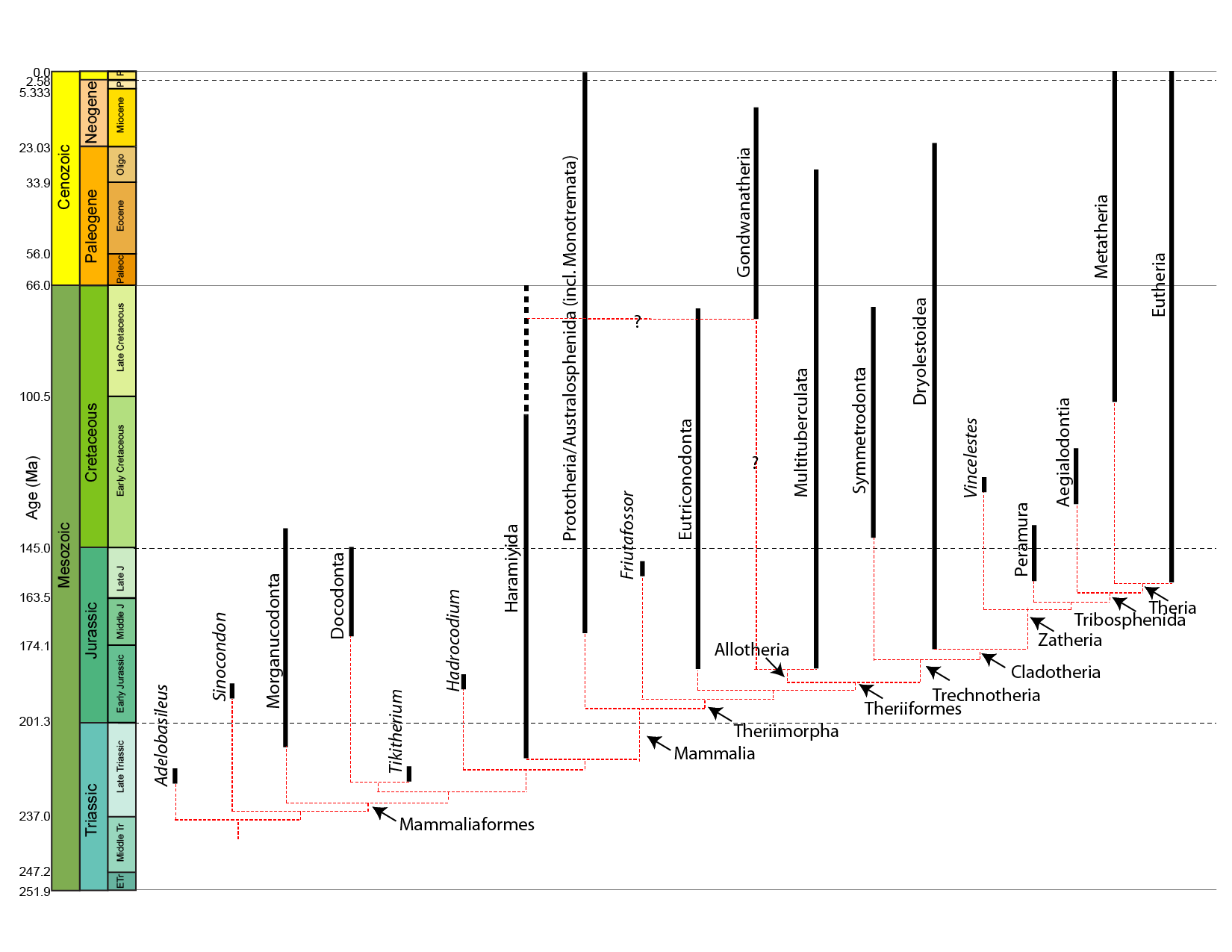
While fur isn't notwithstanding confirmed in moganucodonts, their tiny body size suggests it was necessary (especially if they were endothermic). Fur is definitely present in the clades Docodonta and Haramiyida.
Mesozoic mammals may have been "children of the nighttime". The phylogenetic distribution of behavior, of specialized centre pigments, and of pupil shape strongly propose that the concestor of all mammals (and of all mammaliaforms) was nocturnal. (Cathemerality--activity during both day and night--evolves later and dominates for larger-bodied mammals, and diurnality--activeness limited to daytime--beingness rare, and about mutual in primates.)
Most Mesozoic mammals very small-scale (shrew-to-firm cat sized, with a few badger-sized forms in the Cretaceous); mammals only become big AFTER extinction of non-avian dinosaurs.
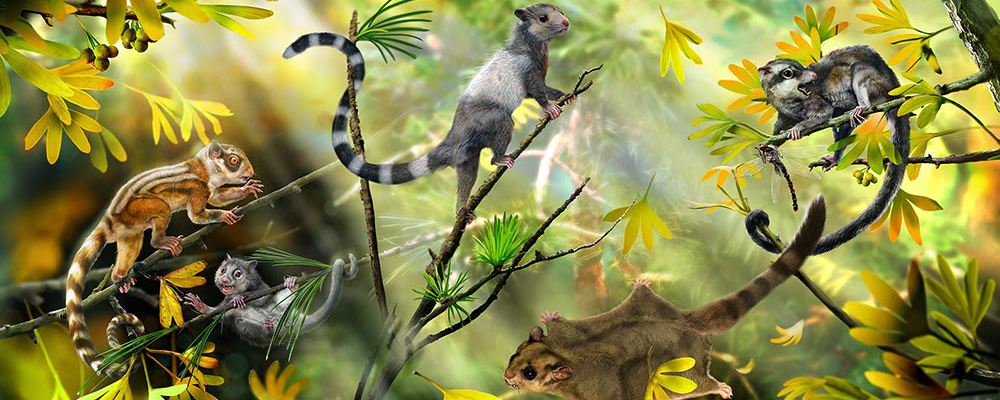
The oldest mammaliforms of the Late Triassic and Early Jurassic were fairly small. Simply by Eye and Late Jurassic, in that location were already some specialized mammals:
- Burrowers in various clades
- Paddle-tailed, spider web-footed fish eaters
- Gliding mammals
A curious discovery in Mesozoic mammals is that many groups have an ankle spur homologous to that in modern monotremes. It isn't certain if they were poisonous and/or if they were express to males. And so even in this "monotreme" trait is non a synapomorphy of this clade, but rather a retention of a symplesiomorphy which is lost in the derived Theria.
Nosotros tend to think of Mesozoic mammals every bit being at the mercy of dinosaurs, but in at to the lowest degree one case the mammals had the upper hand. The badger-sized eutriconodont Repenomamus contains in its gut the remains of several infant dinosaurs.
Some major groups of Jurassic and Cretaceous mammals:
Prototheria (sometimes chosen "Australosphenida"; monotremes and their extinct relatives):
- Generally relatively stumpy legs and tails, even in modern forms
- Oldest from Eye Jurassic onward
- Oldest monotremes proper from Early Cretaceous (peradventure actually a platypus! it has the same electrosensory apparatus); survive today in Australasia equally platypus and echidna
- Prototheres were never a ascendant group, but were once moderately mutual in Gondwana (present in Asia, too)
- Retain ancestral sprawling posture and egg-laying reproduction
- Insectivores?
Eutriconodonta (eutriconodonts):
- Range from tiny to opposum-sized to badger-sized
- Relatively common mammals from the Jurassic and Cretaceous in Laurasia and northern Africa, and also present in Southward America
- Omnivores and carnivores: at least i has gut contents containing the remains of baby Psittacosaurus
- At to the lowest degree i lineage produced gliders
- In their time, were major parts of the larger mammal beast: ecologically comparable to opossums and raccoons in the modernistic U.S.
- Wiped out at cease of Cretaceous
- Fashion of reproduction unknown
Allotheria (allotheres):
- Some studies propose that the basal, poorly known Tardily Triassic "haramiyids" (a paraphyletic group) and the Jurassic tree-climbing euharamiyids are part of this clade; others put these branches exterior the Prototherian + Allotheria + Theria group
- More definite members are the Cretaceous Gondwanatheria, and the diverse Multituberculata.
- Gondwanatheria
- Until recently known but from isolated jaws and teeth, which indicated a gnawing (rodent-similar) diet
- As the proper name implies, known merely from the southern continents
- New discovery of nearly complete skull of Vintana of the Tardily Cretaceous of Madagascar shows at least some gondwanatheres had relatively big brains, very large optics, and well-developed olfaction. Also, Vintana is quite big (well-nigh beaver-sized), making it among the largest of Mesozoic mammals
- Fifty-fifty more complete is its contemporary Adalotherium
- Some gondwanatheres survived in South America until the Miocene Epoch (a mere eighteen one thousand thousand years agone!)
- At least some studies place Gondwanatheria Within Multituberculata
- Multituberculata
- Oldest multituberculate fossils Middle Jurassic; survived into early Cenozoic (about 35 Ma) when they became extinct
- Mode of reproduction unknown
- Many were skillful climbers; others were burrows; still more than may have been terrestrial hoppers
- Extremely common in Laurasia
- Specialized molars and gnawing teeth: convergent with rodents, and a major radiation in this way of life before the true rodents evolved
- Recently discovered trace fossils shows that some of these gnawed on dinosaur basic!
- Gondwanatheria
Amongst the various clades of mammals in the Mesozoic are early on monotremes and stem-members of the two therian groups. Metatheria is the total-group for Marsupialia, and is known from the Early Cretaceous onward. Eutheria, the total-group for Placentalia, goes all the style back to the earliest Belatedly Jurassic. (Of course, as its sister taxon, Metatheria has to extend equally far back in time as Eutheria, simply we oasis't found or identified the Jurassic metatherians yet.) While Marsupialia proper isn't known until the earliest Cenozoic, fossils of crown Placentalia are known before the K/Pg extinction (and based on genetic difference many of the branches may have been present much before in the Cretaceous).
Metatheria (marsupials and their extinct relatives):
- Oldest fossils Early Cretaceous
- Survive today in opossums of the Americas and great diverseness in Australasia (and in Cenozoic were even more than diverse in South America)
- Ironically, though, are known Merely from Laurasia during the Cretaceous
- In marsupials, birth barely-formed young that develop in pouch: not certain yet when non-marsupial metatheres evolved that class of reproduction
- During Mesozoic, metatheres were very common mammals in both Gondwana and Laurasia
- Some very small merely some were amid the largest mammals of the Mesozoic (badger-sized)
- Recent phylogenetic analyses show that there are no definite members of Marsupalia during the Mesozoic, although they are present then early in the Cenozoic that they probably had evolved before the end of the Cretaceous
Eutheria (placentals and our extinct relatives):
- The earliest Tardily Jurassic Juramaia and the Early on Cretaceous Eomaia were once thought to non actually be in Eutheria; the virtually recent rounds of studies, however restores them to the placental ancestry.
- Survive today equally most various group of mammals (including united states!)
- Placental mammals reproduce by keeping young in womb until birth, fed by placenta: non certain how non-placental eutheres reproduced
- Mesozoic eutheres were pocket-sized; many were herbivorous, omnivorous, and insectivorous
- True placentals are not yet known older than the end of the Cretaceous (in fact, the most recent comprehensive study shows that none of the Cretaceous eutheres definitely belong to Placentalia), but it is quite possible that the major divergences had already happened before the end of the Historic period of Dinosaurs
Prototheres, allotheres (as multitubercultates), metatheres (including the first marsupials), and eutheres (including the starting time placentals) all survived the great extinction event at the terminate of the Cretaceous. A few other groups survived also, but the majority of Mesozoic mammal lineages perished in that extinction outcome.
The Flowering of the Age of Dinosaurs: Plants of the Mesozoic
The base of the food chain on state is plants. They use photosynthesis to take in sunlight, carbon dioxide, and water and combining them to produce glucose and oxygen (in other words, the reverse of the aerobic respiration equation).
Plants at the dawn of the age of dinosaurs were very different from those of the mod world: not so much of what was in that location as what wasn't. In that location was no grass, no grain, no fruit, no flowers. Just past the end of the Mesozoic, these were present.
Primitive plants are spore plants. Spore plants are a paraphyletic grade: some are more closely related to seed plants than are others. Spore plants first colonized state in the early on Paleozoic Era.
They reproduce by releasing spores, which settle onto moist surfaces, grow into plants that produce sex cells which meet in the sparse film of water, and join to produce a new spore-producing constitute. (Note that this is somewhat coordinating to amphibian-class tetrapods: plants that alive their life on country, but need to put their sex cells in water to reproduce.)
Various sorts of spore plants be:
- Liverworts
- Mosses
- Clubmosses
- Ferns, including some specialized forms:
- Horsetails (also chosen scouring rushes)
- Tree ferns
All of these were nowadays in the Mesozoic. For most of the Mesozoic the dominant ground cover was ferns, and tree ferns were fairly of import trees in the Triassic and Jurassic.
Spore plants lack true wood (tree ferns cheat by having many stalks growing right next to each other for support), nor do they have complex root systems.
Those traits, however, ARE present in the seed plants. Seed plants outset appear in the mid-Paleozoic Era, and become the ascendant state plants in the Permian Period of the Paleozoic Era.
They reproduce by releasing male sexual practice cells (carried in pollen) which state on female sexual activity organs, bring together with female sex cells, produce a fertilized seed, which can then exist released from the plant to land in the soil and germinate on its own. (This is analogous to the amniotic egg in tetrapods, assuasive plants to colonize farther inland into drier regions.)
All non-flowering seed plants are traditionally grouped into a paraphyletic course, the "gymnosperms": some extinct gymnosperms are more closely related to flowering plants than to other gymnosperms. The living gymnosperms practice form a clade (Acrogymnospermae). Various sorts of gymnosperms be:
- Cycads, once widespread, but now more common in the tropical regions. They expect something like palms and something similar pineapples, but are neither. The include small tree- and shrub-sized species. They were VERY mutual in the Mesozoic.
- Ginkgoes, trees that were widespread in the Mesozoic and Cenozoic but now limited to a unmarried species
- Conifers, highly diverse tree-and-shrub sized species including:
- Pines
- Araucarians
- Cypresses, including junipers, Redwoods, sequoias, and dawn redwoods
- Spruces
- Cedars
- Yews
- And others
- Bennettitaleans, including tree and shrub forms and the only fully extinct group of constitute discussed here!
As today, gymnosperms were an important group of land plants in the Mesozoic. In fact, they were even more common then! Ginkgoes, dawn redwoods, cycads, and bennettitaleans (all rare or extinct today) were major parts of the flora, and major sorts of dinosaur nutrient.
Some gymnosperms (conifers, cycads) wrap their seeds in a fleshy coating, and some (bennitataleans, cycads) had specialized structures effectually their female sexual activity organs to attract insects. Just only in the next group do we get true fruit and true flowers.
Flowering plants, chosen the angiosperms or anthophytes are the major clade of modern plants. With rare exceptions, if you have eaten a plant, information technology was an angiosperm. Angiosperms are a clade within the seed plants. Their mode of reproduction is to develop a specialized set of both male and female sex organs within a flower; pollinators are lured to the blossom, pick up pollen, have pollen rub off on the flower of another plant, where they fertilize the female sex cells, and a seed is made. That seed is covered by a blanket of fleshy or nutty tissue derived from the ovaries: the fruit.
The basic angiosperm life bike hinges on co-evolution with animals:
- Bright colors, attractive smells, and interesting patterns on the flowers attract pollinators (typically flying insects). These move pollen (containing the male sex cells) to flowers of other plants (where the female sex cells are)
- Fruit remains bitter, hard, and irksome colored until the seeds are ready to grow. At that bespeak, the fruit becomes brightly colored, fleshy or nutty, and sweet and juicy. The fruit is so eaten by a vertebrate, which leaves the area and deposits the seeds in its dung.
If angiosperms evolved flowers and fruit in the Cretaceous, who were their target audiences?
- Flower targets?
- Earliest Cretaceous "birds" (flying theropods) were notwithstanding relatively rare, and none show nectar-eating adaptations.
- Mammals were modest, and may have been pollinators, but no bats (the primary modern mammalian pollinators) still.
- Insects (including beetles, flies, lepiodopterans, and hymenopterans) were present, and were near certainly the principal pollinators in the Mesozoic simply as they are today.
- Fruit targets?
- Herbivorous mammals of the Early on Cretaceous were small, and may have eaten berry-sized fruit, but no more than than that
- Hebivorous crocodyliforms were rare
- Simply herbivorous dinosaurs were VERY common, and could easily consume and transport a LOT of fruit!
So thank the insects for flowers, and thank the dinosaurs for fruit.
The rise of the angiosperms occurs about the aforementioned time that low-browsing herbivorous dinosaurs (ankylosaurs, iguanodontians, rebbachisaurids) become dominant over medium (stegosaur) and high (typical sauropod) browsers. Are these changes linked? Although angiosperms were nowadays in the Early on Cretaceous, they seem to have been relatively rare then, and unlikely to have been a major food source for these groups at showtime. But information technology may be that increase in low-browsing forms favored the spread of herb-sized angiosperms.
Past the Late Cretaceous many modern clades of angiosperms were present (mangolias, rose-relatives, maples, etc.). Also during this fourth dimension the first grass appears. Grasses include not merely the stuff that grows in lawns and meadows, but all the grain-producing plants (wheat, barley, etc.), as well every bit bamboo. Their flowers are extremely small, and they are often wind-pollinated rather than by the aid of insects.
Grasses grow from the base of operations of the foliage rather than the tip. They often have petty $.25 of silica in them to persuade herbivores not to eat them. Contempo discoveries in both Laurasia and Gondwana: the latter were found in titanosaur sauropod coprolites! So at leastsome Cretaceous dinosaurs were grass eaters. Still, grasses seem to take been relatively rare in the Mesozoic, and did not grade grasslands until much later. Footing embrace in the afterward Mesozoic was a mixture of ferns and herbaceous angiosperms. And so as far as we know, no dinosaur other than birds ever wandered in prairies or savannahs: these appear much later, long after the cease of the Mesozoic.
Some relevant videos:
To Next Lecture.
To Previous Lecture.
To Lecture Schedule.
Last modified: 26 July 2021
Source: https://www.geol.umd.edu/~tholtz/G104/lectures/104shadow.html
Posted by: weissthemanty.blogspot.com
0 Response to "1. In The Mesozoic Era, Angiosperms Rapidly Expanded. Which Group Of Animals Mirrored It?"
Post a Comment