

Can I Use My Vacuum Without The Hepa Filter
No ane wants to vacuum their house without coming away feeling satisfied that they've created a clean, salubrious environment. We want to know we've successfully ridded the air and carpets of all the grit, pollen, bacteria, and other particulates that plague most homes.
Enter the loftier-efficiency particulate air filter, better known equally a HEPA filter.
Like other authorities standards, HEPA has become firmly entrenched in our lexicon, used to bespeak a higher standard of decontamination. Attached to a vacuum cleaner, HEPA filters capture smaller particulates that might otherwise not be trapped by your vacuum, providing added relief for allergy sufferers and cleaner air for all.
But costing several times the corporeality of conventional filters, are HEPA filters worth the added expense?
Originally designed in the 1940s to forbid the spread of airborne radioactive contaminants, the HEPA filter before long made its way into commercial—and somewhen residential—applications. A true HEPA filter, as defined by the U.S. Department of Energy, removes at least 99.97 percent of airborne particles that are 0.iii micrometers in diameter.
How small is that? The average human hair is virtually 100 micrometers in bore. That's roughly 300 times the size of what a HEPA filter will trap.
"For most allergens, the particles are bigger than 0.3 micrometers," explains Jeffrey May, air quality consultant and writer of My Business firm is Killing Me. "You don't demand a HEPA filter to stop dust mite, and pollen particles, as they are relatively huge. Whatever skillful vacuum cleaner should finish cat hair and dander."
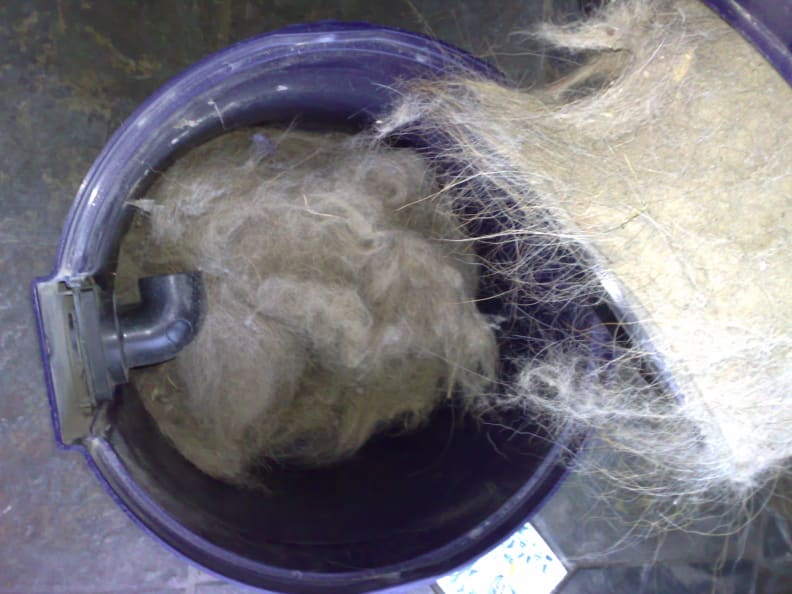
Animal hair will be picked up by conventional vacuums, even without a HEPA filter.
But May says that HEPA filters assist contribute to a healthy home environment, fifty-fifty for those without allergies or asthma. A HEPA filter traps most leaner, pathogens, microbial spores, tracked-in soil particles, combustion soot particles, some structure dust, and some virus particles (that are stuck on larger particles).
"Although the level of filtration is a lot more than virtually of us need, I remember it makes people feel good. And more recently, epidemiological studies are showing that small particles of less than a micron may be causing hypertension."
The Asthma and Allergy Foundation of America (AAFA) has a certification program with guidelines for vacuum cleaners, but the guidelines don't specifically crave HEPA filters.
"We effort to create an environment where the manufacturer can exist innovative, as long as the product still passes the strict standards adopted by AAFA," says Alicia Elkin, make director for AAFA's Certification Program.
AAFA currently certifies 33 vacuum cleaners—all from the Dyson, Kenmore and Samsung labels—plus the very expensive Rainbow Cleaning Arrangement, which uses a water filtration process.
But New York-based allergist Dr. Clifford Bassett suggests allergy sufferers should not wait exclusively to vacuum cleaners with HEPA filters to provide a complete solution for their allergy or asthma issues.
"Things like this work, but a HEPA filter should be part of a comprehensive, overall program," Dr. Bassett adds. "You desire an indoor allergy action plan."
If a HEPA filter is what you lot want, the Healthy House Institute says the most important features in a vacuum cleaner are the HEPA filter itself and how it is held in place:
"The filter itself should be made of a pleated, semi-rigid material held in a frame. The frame must exist held tightly in place by an closed gasket. The gasket prevents allergy-laden air from bypassing the filter. Some vacuum cleaners take flimsy, pleated paper filters that look like the textile in legitimate HEPA filters; other vacuums have efficient filters in a rigid frame but the filter frame is non held tightly in place, so allergens laissez passer around the filter instead of through it, and escape from the vacuum cleaner. A cream filter is non a HEPA filter."
When buying vacuum cleaner bags, avert products advertised as "HEPA-style" or "HEPA-like," where filtration standards are probably not equally rigorous. An "anti-allergen" characterization is not the same as HEPA.
Jeffrey May says how you vacuum can be just as important as the product y'all apply. Carelessly attacking carpets can result in more dust existence sent into the air than is nerveless by the vacuum cleaner.
"If you're going to spend the money to purchase a HEPA vacuum, you need to vacuum slowly and methodically," suggests May. "Otherwise yous're wasting your money."
"Whatever proficient vacuum cleaner should stop cat pilus and dander."
So, if you lot keep a tidy house to begin with, a HEPA filter on your vacuum probably won't make much of a divergence every bit to whether you take a runny nose during pollen season. It'southward not going to collect pet hair and dander better than a regular vacuum, nor volition it remove odors.
Merely although a HEPA filter is non a magic bullet by itself, careful vacuuming with a HEPA filter will assistance grab some of the smaller environmental contaminants we live with. For a cleaner home, they're worth the added expense. And if you have acute allergies, asthma, COPD or other respiratory conditions, HEPA filters are an important component of a healthier home.

Can I Use My Vacuum Without The Hepa Filter,
Source: https://www.reviewed.com/vacuums/features/do-i-need-a-hepa-filter-for-my-vacuum-cleaner
Posted by: weissthemanty.blogspot.com
0 Response to "Can I Use My Vacuum Without The Hepa Filter"
Post a Comment